📌 Master Guide Navigation:
This article is Part-1 of our complete ICT Fair Value Gap Guide Series. To explore the entire master framework from basic definitions to high-frequency execution models, visit our cornerstone hub: The Complete ICT Fair Value Gap(FVG) Master Guide
Introduction: What Is an ICT Fair Value Gap?
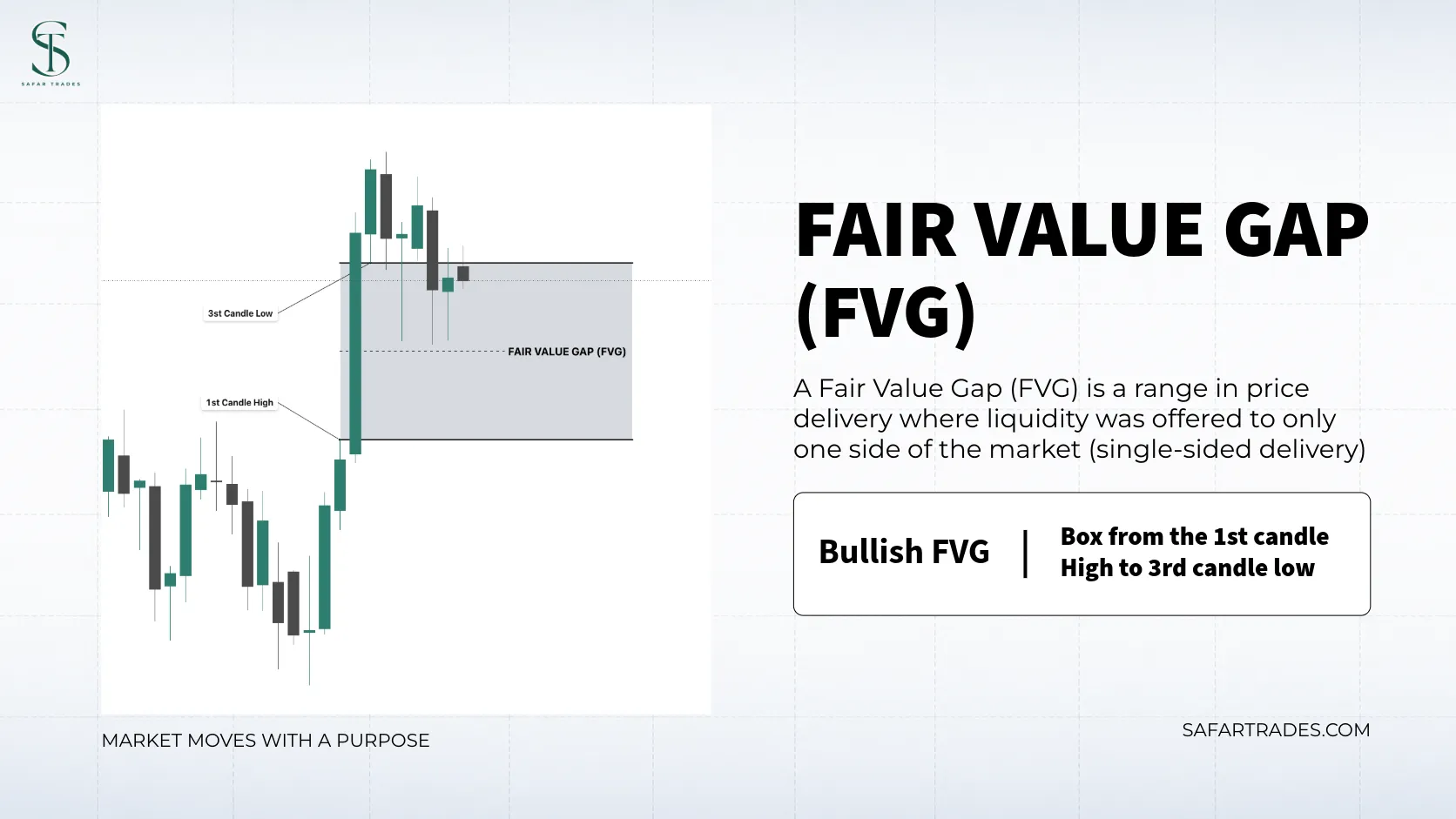
In the Inner Circle Trader (ICT) methodology, a Fair Value Gap (FVG) is defined as a specific range in price delivery where liquidity was offered to only one side of the market—creating a single-sided price imbalance.
When the market moves aggressively in one direction, it creates an inefficiency where price was delivered rapidly without overlapping two-sided trading. Because institutional algorithms operate on a continuous market efficiency mandate, an open Fair Value Gap acts as an algorithmic reference point or “magnet” that the price engine will revisit to offer two-sided efficiency before resuming its overarching move.
RETAIL MYTH vs. ICT ALGORITHMIC REALITY
❌ Retail Supply/Demand: “Buyers outnumbered sellers, driving price up.”
✅ ICT IPDA Mechanics: “IPDA repriced the market single-sidedly (BISI), leaving a sell-side inefficiency that must be rebalanced.”
Algorithmic Origin: IPDA vs. Retail Supply & Demand Myths.
One of the foundational principles taught by ICT is that Fair Value Gaps are not caused by traditional buying and selling pressure or retail supply and demand imbalance.
IPDA DELIVERY MECHANICS
[Liquidity Pool / Target] ◄── IPDA spools price toward resting orders ▲ │ [Fair Value Gap (BISI)] ◄── Single-sided delivery rebalanced by IPDA ▲ │ [Institutional Origin] ◄── Position accumulation during displacement
Key Algorithmic Distinctions:
- The Interbank Price Delivery Algorithm (IPDA): Price is governed and delivered directly by IPDA, which operates on pre-programmed time and price parameters.
- Single-Sided Delivery: When IPDA spools price rapidly to reach a target or purge liquidity, it delivers price to only one side of the order book (buy-side only or sell-side only).
- Rebalancing Mandate: IPDA is coded to maintain a continuous cycle of efficiency. Every price level should ideally be offered at least two times (once going up and once going down). When a gap is left open, the algorithm treats it as unfinished business and retraces back into the range to offer contrarian liquidity.
3. The Strict Three-Candle Structure Mechanics
A Fair Value Gap is never identified on a single candle or random chart space; it is defined across a strict three-candle sequence:
- Candle 1 (Boundary Candle): The initial candle establishing the starting price boundary prior to the move.
- Candle 2 (Displacement Candle): The energetic, long-bodied candle that creates the single-sided imbalance.
- Candle 3 (Boundary Candle): The subsequent candle following displacement, whose extreme fails to touch Candle 1’s extreme.
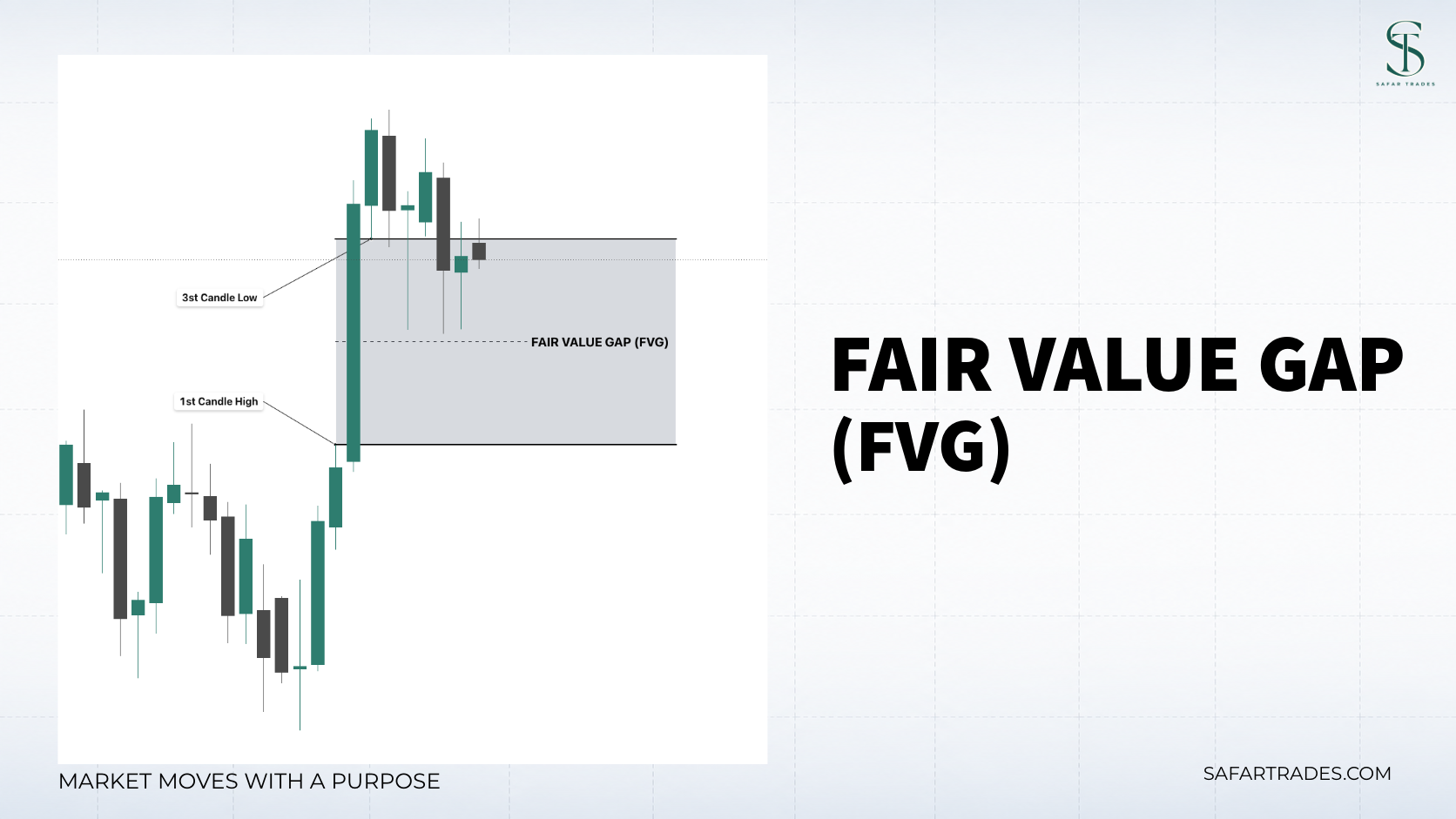
A Fair Value Gap exists in the open, un-traded price space across Candle 2 where Candle 1’s extreme and Candle 3’s extreme fail to overlap.
       BULLISH FVG (BISI)                   BEARISH FVG (SIBI)

          [Candle 3]                            [Candle 1]
           High/Low                              High/Low
              |                                     |
          +-------+                             +-------+
          |       |                             |       |
          +-------+                             +-------+
              |                                     |
  ========== Low of Candle 3 [Top]      ======== High of Candle 3 [Bottom]
  |                                     |
  |  [ FAIR VALUE GAP RANGE ]           |  [ FAIR VALUE GAP RANGE ]
  |  [ Consequent Encroachment (50%)]   |  [ Consequent Encroachment (50%)]
  |                                     |
  ========== High of Candle 1 [Bottom]  ======== Low of Candle 1 [Top]
              |                                     |
          +-------+                             +-------+
          |       |                             |       |
          +-------+                             +-------+
              |                                     |
          [Candle 1]                            [Candle 3]
4. Bullish Fair Value Gap: BISI (Buy-Side Imbalance / Sell-Side Inefficiency)
A Bullish Fair Value Gap is algorithmically classified as a BISI (Buy-Side Imbalance / Sell-Side Inefficiency).
- Anatomy & Formation: Created during an energetic, up-close displacement candle (Candle 2).
- Gap Boundaries: Measured strictly from the High of Candle 1 (bottom boundary) to the Low of Candle 3 (top boundary).
- Algorithmic Narrative: During Candle 2’s upward move, price was offered exclusively to buy-side liquidity, leaving the range completely inefficient in sell-side delivery. When price subsequently retraces down into the BISI, IPDA delivers sell-side price action into the gap, rebalancing the market so it can expand higher toward opposing buy-side liquidity targets.
5. Bearish Fair Value Gap: SIBI (Sell-Side Imbalance / Buy-Side Inefficiency)
A Bearish Fair Value Gap is algorithmically classified as a SIBI (Sell-Side Imbalance / Buy-Side Inefficiency).
- Anatomy & Formation: Created during an energetic, down-close displacement candle (Candle 2).
- Gap Boundaries: Measured strictly from the Low of Candle 1 (top boundary) to the High of Candle 3 (bottom boundary).
- Algorithmic Narrative: During Candle 2’s downward move, price was offered exclusively to sell-side liquidity, leaving the range inefficient in buy-side delivery. When price retraces up into the SIBI, IPDA delivers buy-side price action into the gap to complete two-sided market efficiency before spooling lower toward sell-side liquidity pools.
6. The Algorithmic Midpoint: Consequent Encroachment (CE) & The “Bodies vs. Wicks” Rule
To grade and qualify an FVG accurately, ICT applies specific mathematical and candlestick containment rules:
A. Consequent Encroachment (CE)
- Definition: The exact 50% mathematical midpoint of any gap, FVG, liquidity void, or wick.
- Formula:
\[\text{Consequent Encroachment (CE)} = \frac{\text{Upper Boundary} + \text{Lower Boundary}}{2}\] - Role: Consequent Encroachment acts as a primary line of defense for institutional order flow. In strong, high-probability trend conditions, price will respect the 50% CE level.
Nomenclature Note: Do not confuse Consequent Encroachment (CE) with Mean Threshold. CE applies strictly to gaps, inefficiencies, and wicks, whereas Mean Threshold represents the 50% midpoint of an Order Block or solid candle body.
B. The “Bodies vs. Wicks” Rule
When evaluating how price responds to a Fair Value Gap, apply ICT’s core rule:
\[\text{\textbf{’‘The wicks do the damage, but the bodies tell the narrative/story.’’}} \quad\]
  EVALUATING FVG RETEST ACTION

  ✅ VALID HOLD (Bullish BISI)              ❌ FVG INVALIDATION (Bullish BISI)

  Candle 3 Low                              Candle 3 Low
  ===========================               ===========================
        |    <-- Wick Mohawk                      |     |
     +-----+     (Coloring outside lines)      +-----+  |  <-- Candle Body
     |     |     Body CLOSES ABOVE             |     |  |      CLOSES DEEP
     +-----+     CE / Gap                      +-----+  v      BELOW CE / GAP
  ===========================               ===========================
Candle 1 High Candle 1 High- Wicks (Damage): Wicks represent stop raids and liquidity sweeps. Price is permitted to drive a wick through an FVG boundary or past CE (a minor overshoot called a Mohawk) to run stops.
- Bodies (Narrative): Candlestick bodies contain true institutional volume. For a Bullish BISI to remain valid, candlestick bodies must respect the boundaries or close on the favorable side of Consequent Encroachment (50% CE). A full body close beyond the FVG invalidates the setup.
7. Section Summary & Key Takeaways
| Feature | Bullish BISI | Bearish SIBI |
|---|---|---|
| Classification | Buy-Side Imbalance / Sell-Side Inefficiency | Sell-Side Imbalance / Buy-Side Inefficiency |
| Displacement Candle | Up-close displacement candle (Candle 2) | Down-close displacement candle (Candle 2) |
| Gap Boundaries | Candle 1 High to Candle 3 Low | Candle 1 Low to Candle 3 High |
| Algorithmic Role | Acts as support in Discount for long entries | Acts as resistance in Premium for short entries |
| 50% Midpoint | Consequent Encroachment (CE) | Consequent Encroachment (CE) |
🔜 **Next Up in the Series:**Now that you understand the algorithmic definition and 3-candle mechanics of a Fair Value Gap, move on to Part 2: How Does an ICT Fair Value Gap Form? Imbalance, Displacement & Delivery Mechanics.