
To trade systematically with smart money concepts, you must learn to read structure. In this extensive guide, we break down structure shifts and continuation patterns.
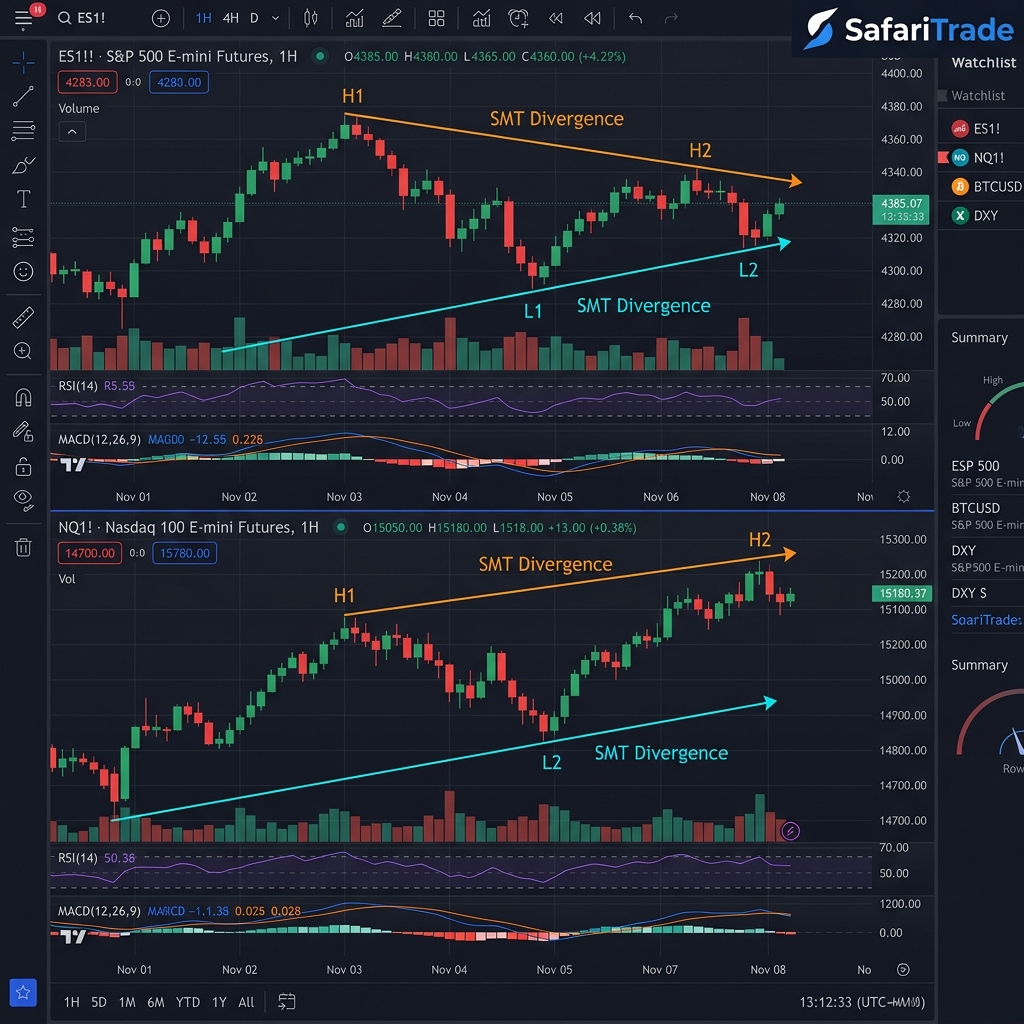
Trend Analysis Fundamentals
Before identifying shifts, we must define an established trend. An uptrend consists of a series of Higher Highs (HH) and Higher Lows (HL). Conversely, a downtrend consists of Lower Highs (LH) and Lower Lows (LL). Algorithmic pricing engines deliver liquidity by moving from one pool of external liquidity to another. As long as these structural reference points hold, the trend is considered active and intact. Understanding this flow prevents you from trading counter-trend.
Anatomy of a Break of Structure (BOS)
A Break of Structure (BOS) represents trend continuation. In an uptrend, a BOS is confirmed when price successfully breaks and closes above the previous swing high. In a downtrend, a BOS occurs when price closes below the previous swing low.
Key characteristics of a valid BOS:
- Candle Body Close: Wicks do not count. The candle body must close past the structural level.
- Volume Expansion: Shows participation from institutional order flow.
- Trend Confirmation: It signals that the current market direction remains dominant.
Anatomy of a Market Structure Shift (MSS)
A Market Structure Shift (MSS) represents trend reversal. It signals that the institutional order flow has changed direction. An MSS occurs when price sweeps key liquidity (e.g. old highs or lows) and then aggressively closes past the previous opposing swing point.
Unlike a BOS, which simply continues the trend, an MSS breaks the established chain of Higher Lows or Lower Highs. It is the first warning sign of a major market reversal.
The Role of Liquidity Sweeps
Almost every high-probability MSS is preceded by a liquidity sweep. Algorithmic pricing engines require counterparty liquidity to execute large block orders. By running price past key swing highs (buy-side liquidity) or swing lows (sell-side liquidity), institutions accumulate positions before shifting the market direction.
If you see a structure shift without a prior liquidity sweep, it is highly likely to be a retail trap or a false breakout.
Displacement and Gap Formation
For an MSS to be considered high-probability, it must show displacement. Displacement is characterized by rapid, energetic price movement represented by large-bodied candles.
This aggressive movement leaves behind imbalances known as Fair Value Gaps (FVG) or Inversion FVGs (IFVG). If price shifts structure slowly with small, overlapping candles, it lacks displacement, and the setup should be discarded.
Retail Traps and Mitigations
Retail traders often confuse a simple stop hunt (wick sweep) with a structure shift. To avoid these traps, always wait for the candle close. If price runs a low but closes back inside the range, it is a sweep, not a shift.
Additionally, high-probability setups often involve a retest of the mitigation block or breaker block formed during the displacement leg. Entering on the retest of these zones provides optimal risk-to-reward metrics.
Multi-Timeframe Confluence
Structure is fractal, meaning shifts happen on all timeframes. However, low-timeframe (LTF) shifts are only high-probability if they align with the higher-timeframe (HTF) draw on liquidity.
For example, if the HTF draw on liquidity is bullish, seek a bullish MSS on the 1-minute or 5-minute timeframe inside an HTF key discount array (like a daily FVG or order block).
Step-by-Step Execution Plan
To execute setups systematically, use this checklist:
- Identify the HTF Draw: Determine where price is heading on the 4H/Daily chart.
- Wait for HTF Array Reach: Let price enter an HTF FVG, Order Block, or sweep an HTF high/low.
- Monitor LTF (1M/5M): Look for a liquidity sweep followed by a displacement leg.
- Confirm the MSS: Wait for a candle body close past the swing high/low.
- Identify entry zone: Locate the FVG, Breaker, or Mitigation block inside the displacement leg.
- Set stop-loss: Place your stop below the sweep low/high.
- Target next liquidity pool: Set take-profit targets at key opposing swing points.